

The Schmidtko Lab
Welcome!
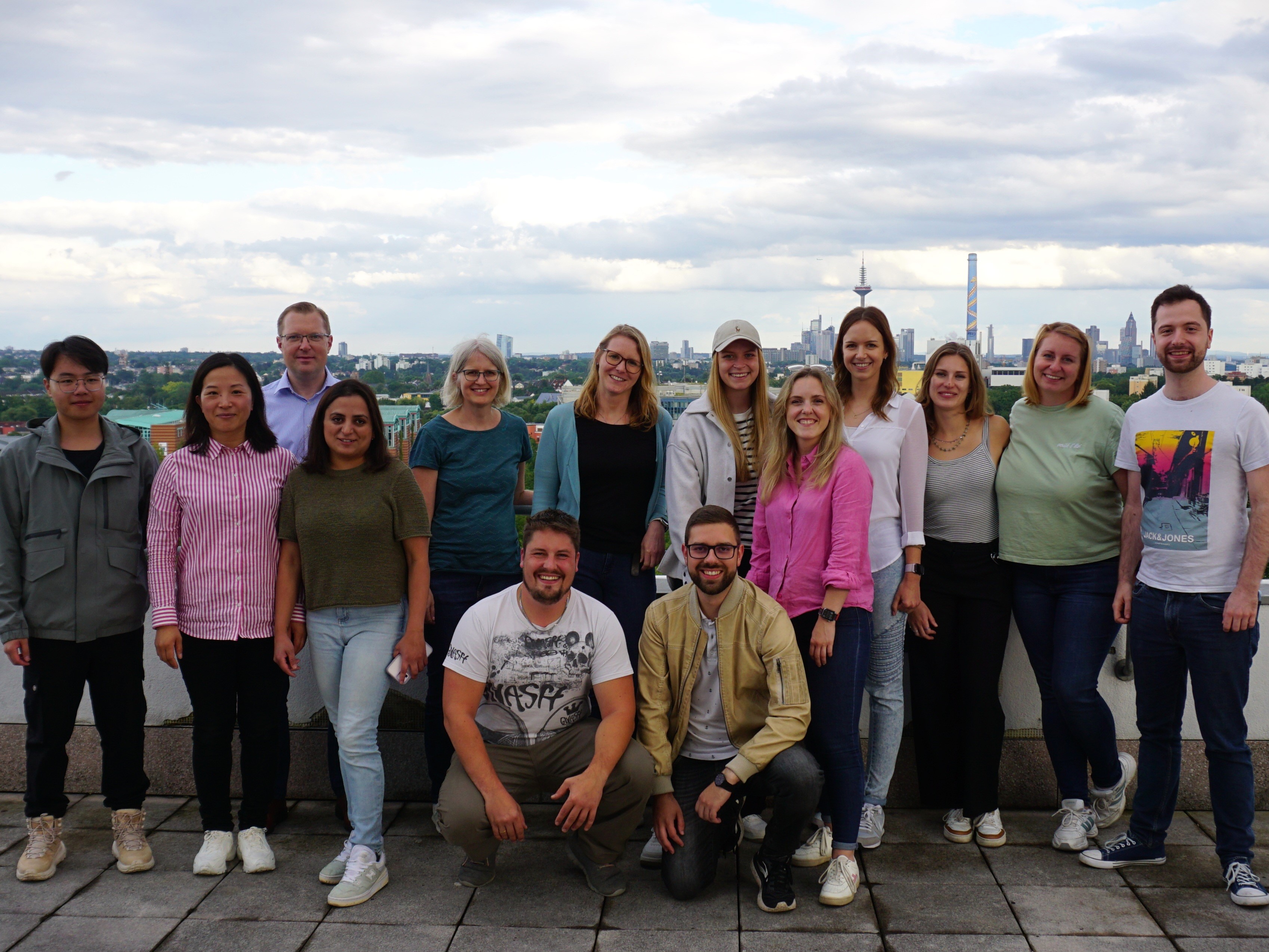
from left: Jingtao Zou, Ruirui Lu, Prof. Achim Schmidtko, Sabina Hassan, Sylvia Osswald, Patrick Engel, Wiebke Kallenborn-Gerhardt, Yannick Federkiel, Chantal Nagel, Hannah Gerninghaus, Amelie Menge, Annika Balzulat, Katharina Metzner, Christoph Jacobs
(not shown: Huiming Tang, Nelly Urban, Nico Wolfschlag, Tim Berg, Andrea Holzfuß, Xiaojuan Xiong, Katharina Höfer)
Research interests
Research interests
Our research aims to understand the molecular mechanisms behind pain and itch, and to identify new molecular targets for an effective therapy.
Pain – in an acute setting – serves as an important protective mechanism for drawing attention to potentially injured tissue. However, in chronic pain conditions, e.g. in the context of inflammation or neuropathies, pain loses its protective function and can become a disease in its own right. Typical of these persistent pain conditions are an increased response to painful stimuli (hyperalgesia), a painful perception of low-threshold stimuli (allodynia) and the development of spontaneous pain without an identifiable cause. This sensitization of pain pathways represents a major therapeutic problem, particularly in patients with chronic pain, which can often only be treated inadequately with the currently available drugs.
Itch (also known as pruritus) is defined as an unpleasant sensation that evokes a desire to scratch. Like pain, acute itching serves as an important protective mechanism for detecting potentially harmful stimuli. However, chronic itch (i.e., persisting for more than 6 weeks) no longer serves a useful function but instead imposes suffering and may compromise the quality of life to a degree often comparable to that seen in chronic pain. Depending on whether histamine release is involved, itching can be broadly divided into histamine-dependent (histaminergic) and histamine-independent (nonhistaminergic) itching. As most types of chronic itch are histamine-independent and, therefore, resistant to antihistamines, there is an urgent need to develop novel treatment strategies.
To investigate the neuropharmacology of pain and itch we use a range of techniques including classical pharmacology, molecular biology, biochemistry, electrophysiology and microscopic imaging, At the center of our research interest is the question which messengers and receptors are involved. By uncovering these new signaling pathways, as well as identifying novel targets on peripheral sensory neurons and spinal cord neurons, we aim to develop more effective therapies for chronic pain and chronic itch.
Publications
Publications
Recent selections:
· Metzner K, Hussein-Zahovic T, Behery Y, Fenske S, Biel M, Schmidtko A (2026) Impaired touch sensation on hairy skin in HCN3-deficient mice. Front. Neurosci. 19:1697582.
· Berg T, Metzner K, Bahrami N, Wang E, Koch M, Eaton P, Schmidtko A, Kallenborn-Gerhardt W (2025) Redox-dependent activation of protein kinase G1α contributes to transient receptor potential cation channel subfamily V member 1-mediated acute nociceptive pain behavior. Redox Rep. Dec;30(1):1-17.
· Engel P, Gross T, Wack G, Sinderwald R, Burgers L, Fürst R, Schmidtko A (2025) The mRNA Translation Inhibitor Vioprolide A Prevents Inflammatory Pain-Like Behaviour With Limited Action on Already Established Pain-Like Behaviour in Mice. Eur J Pain. Sep;29(8):e70099.
· Gerninghaus H, Isensee J, Kennel L, Zhou F, Kaiser A, Gross T, Flauaus C, Engel P, Jacobs C, Petersen J, Kallenborn-Gerhardt W, Lu R, Metzner K, Adler J, Ruth P, Lukowski R, Hucho T, Schmidt H, Schmidtko A (2025) Nociceptor-specific signaling of the receptor guanylyl cyclase Npr2 contributes to acute and persistent pain. Sci Signal. 18(889):eadq4238. https://www.science.org/stoken/author-tokens/ST-2655/full
· Gross T, Stehle D, Nagel C, Zhou F, Duman E, Hernandez-Olmos V, Sinderwald R, Gerninghaus H, Petersen J, Feil S, Kallenborn-Gerhardt W, Lu R, Metzner K, Feil R, Proschak E, Schmidtko A (2025) Inhibition of Phosphodiesterase 10A Alleviates Pain-like Behavior in Mice. Anesthesiology. 142(2):332-348.
· Engel P, Zhou F, Tran BTT, Schmidtko A, Lu R (2024) Slick potassium channels limit TRPM3- mediated activation of sensory neurons. Front Pharmacol. 15:1459735.
· Zhou F, Engel P, Ruth P, Lukowski R, Schmidtko A, Lu R (2024) Slack potassium channels in spinal dorsal horn neurons control neuropathic pain and acute itch. PAIN ():10.1097
· Balzulat A, Zhu WF, Flauaus C, Hernandez-Olmos V, Heering J, Sethumadhavan S, Dubiel M, Frank A, Menge A, Hebchen M, Metzner K, Lu R, Lukowski R, Ruth P, Knapp S, Müller S, Steinhilber D, Hänelt I, Stark H, Proschak E, Schmidtko A (2024) Discovery of a Small Molecule Activator of Slack (Kcnt1) Potassium Channels That Significantly Reduces Scratching in Mouse Models of Histamine-Independent and Chronic Itch. Adv Sci. e2307237.
· Kallenborn-Gerhardt W, Schröder K, Schmidtko A (2022) NADPH Oxidases in Pain Processing. Antioxidants 11(6):1162.
· Zhou F, Metzner K, Engel P, Balzulat A, Sisignano M, Ruth P, Lukowski R, Schmidtko A, Lu R (2022) Slack Potassium Channels Modulate TRPA1-Mediated Nociception in Sensory Neurons. Cells 11(10):1693.
· Flauaus C, Engel P, Zhou F, Petersen J, Ruth P, Lukowski R, Schmidtko A, Lu R (2022) Slick Potassium Channels Control Pain and Itch in Distinct Populations of Sensory and Spinal Neurons in Mice. Anesthesiology 136:802–822
· Metzner K, Gross T, Balzulat A, Wack G, Lu R, Schmidtko A (2021) Lack of efficacy of a partial adenosine A1 receptor agonist in neuropathic pain models in mice. Purinergic Signal 17, 503–514.
· Wack G, Metzner K, Kuth MS, Wang E, Bresnick A, Brandes RP, Schröder K, Wittig I, Schmidtko A, Kallenborn-Gerhardt W (2021) Nox4-Dependent Upregulation of S100A4 after Peripheral Nerve Injury Modulates Neuropathic Pain Processing. Free Radic Biol Med. S0891-5849(21)00180-5.
· Lu R, Metzner K, Zhou F, Flauaus C, Balzulat A, Engel P, Petersen J, Ehinger R, Bausch A, Ruth P, Lukowski R, Schmidtko A (2021) Functional Coupling of Slack Channels and P2X3 Receptors Contributes to Neuropathic Pain Processing. Int. J. Mol. Sci. 22, 405.
Methods
Methods
Tissue staining
- Immunofluorescence, immunohistochemistry
- RNA in situ hybridization, RNAscope
Molecular biological methods
- SDS-PAGE/Western blot
- Real-time qPCR
- Detection of reactive oxygen species
In vivo models
- Nociceptive pain models
- Neuropathy models
- Itch models
Cell culture
- Neuronal primary cultures from dorsal root ganglia
- Human and murine neuroblastoma cells
- Live Cell Imaging
Electrophysiology
- Patch-clamp
- Calcium imaging